


The Foundation Dedicated to Discovering a Cure for Neuroendocrine Cancer

Caring for Carcinoid Foundation

Research

Syndicate content
What is "personalized medicine"?

Personalized medicine relies on the discipline of "genomics." By analyzing a patient's tumor and comparing tumor cells to other cells in the body, researchers can identify mutations present only in the cancerous cells. These mutations become ideal targets for therapies designed to destroy cancer cells while leaving other cells unharmed.

Read on for more information.

Will neuroendocrine tumor research benefit other cancers?

Yes, neuroendocrine tumor research funded by the Caring for Carcinoid Foundation will benefit other cancers.

Our research grants include analysis of islet cell neuroendocrine cancer--also known as pancreatic neuroendocrine cancer--because that cancer is nearly identical to carcinoid at the cellular level.  Also, our funded research will deepen our genetic and molecular understanding of neuroendocrine tumors and thereby benefit several other neuroendocrine cancers, gastrointestinal cancers, and potentially prostate cancer.


Why is it the right time to fund neuroendocrine tumor research?

It is the right time to fund neuroendocrine tumor research because the new genetic research paradigm has made it possible to discover a cure.

We live in a tremendously exciting time for cancer research.  The completion of the Human Genome Project (HGP) in 2003 marked a watershed in cancer research because it enabled scientists to study cancer at the genetic level and develop novel, targeted therapies.  The HGP was a thirteen-year effort coordinated by the National Institutes of Health and Department of Energy.  Its goals were to identify all the approximately 20,000-25,000 genes in human DNA, determine the sequences of the 3 billion chemical base pairs that make up human DNA, store this information in databases, improve the tools for data analysis, and transfer related technologies to the private sector.

Why does neuroendocrine tumor research lag far behind other cancer research?

Historically, neuroendocrine tumors have attracted few research dollars and little scientific attention because of its low incidence rate. In contrast, other cancers have much higher incidence rates and so receive much greater attention from researchers.

This situation is especially unfortunate because the low incidence rate of neuroendocrine tumors may be illusory.  Post-mortem studies have shown that people have neuroendocrine tumors at a far higher rate than detected during their lifetimes.  Neuroendocrine tumors often goes undetected because the physician community is relatively less experienced with this cancer and how to detect it early.


How does the Caring for Carcinoid Foundation award research grants?

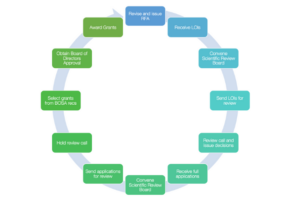
The Caring for Carcinoid Foundation believes in fairness, independence, expertise, and timeliness when awarding research grants.  Therefore, we award research grants by strictly following the NIH guidelines for peer review.  The NIH's Center for Scientific Review defined these peer review guidelines for the following purpose:

"Since 1946, our mission has remained clear and timely:  to see that NIH grant applications receive fair, independent, expert, and timely reviews -- free from inappropriate influences -- so NIH can fund the most promising research."

The Caring for Carcinoid Foundation rigorously follows the NIH peer review guidelines by taking five steps:

Which scientists does the Caring for Carcinoid Foundation fund?

The Caring for Carcinoid Foundation funds leading scientists who undertake cutting-edge, genetically-based neuroendocrine tumor research. These scientists may be located anywhere in the world.

The Caring for Carcinoid Foundation believes collaboration is the cornerstone of breakthrough scientific research.  Therefore, we require all funded scientists to work together by sharing their data, discoveries, and ideas.  This sharing occurs at our annual Research Symposium and in the course of research.


What carcinoid research does the Caring for Carcinoid Foundation fund?

The Caring for Carcinoid Foundation funds neuroendocrine tumor research that will unlock the genetic causes of neuroendocrine tumor and lead to new, targeted therapies.  We crafted a 3-step Research Road Map with our Board of Scientific Advisors to guide all funding decisions:

  • Step 1:  Genomic and proteomic research to unlock the genetic mutations that cause neuroendocrine tumors
  • Step 2:  Molecular pathway research to determine how neuroendorine tumors multiply and metastasize in the body
  • Step 3:  Clinical research to identify and develop new, genetically-targeted drugs

The Caring for Carcinoid Foundation funds all three steps in parallel to discover cures for neuroendocrine cancers as quickly as possible.